Europe's ten highest-earning football clubs now generate almost half of their combined operating revenue from commercial and other activities. But what does a football club sell when it doesn't have a global audience, an established commercial brand or thousands of spectators filling its stadium every week?
It's a question I believe deserves more attention as Canadian soccer continues to expand.
A recent study by Football Benchmark and World Football Summit found that commercial and other income represented 49% of the combined operating revenue of Europe's ten highest-earning clubs in 2024/25, compared with 32% in 2008/09. Over the same period, broadcasting's share declined from 42% to 32%, while their combined revenues more than tripled to €8.4 billion.
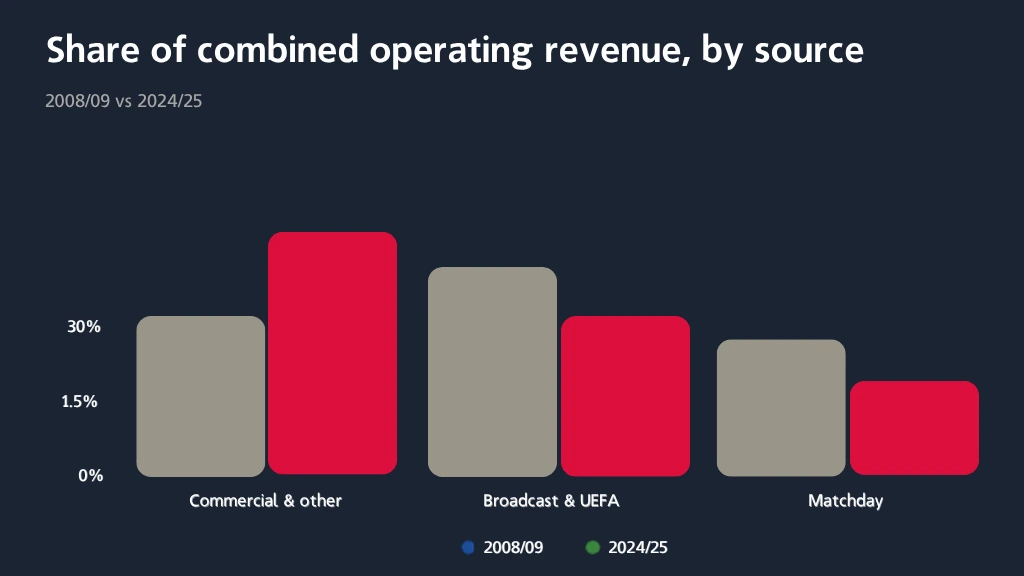 Football Benchmark / World Football Summit, October 2026. Shares rounded.
Broadcasting hasn't necessarily become less valuable. Rather, the largest clubs have developed sophisticated commercial operations, creating revenue through partnerships, merchandising, licensing, hospitality and experiences that extend well beyond matchday.
These organizations have spent decades building their brands, audiences and commercial capabilities. Their global reach now provides opportunities that most football clubs simply don't possess.
And that raises an important question for those of us involved in developing professional soccer in Canada.
What can we learn from these organizations when the commercial foundations of our own leagues and clubs are still being established?
Building commercial value without a global audience
The Canadian Premier League has created an important domestic professional platform since its launch in 2019. But establishing the competition and developing financially sustainable clubs are two different challenges.
Running a professional football organization requires substantial investment in players, staff, facilities, travel and competition delivery. Many of these costs exist regardless of how many spectators attend.
Yet the commercial opportunities available to CPL clubs differ considerably between markets.
As professional soccer continues to expand, we cannot assume that every new club will immediately attract several thousand supporters to its home matches. Building an audience, a local identity and meaningful corporate relationships takes time, particularly in markets where professional soccer is still establishing itself.
For a club with a relatively modest matchday audience, selling sponsorship primarily on stadium exposure can be difficult. A national brand seeking broad consumer reach may simply not find sufficient value in those impressions alone.
But that doesn't mean the club lacks commercial potential.
A professional football club can connect businesses with specific communities, customers and experiences. It can create opportunities for client entertainment, employee engagement, local marketing and partnerships that extend beyond the stadium.
Atlético Ottawa's Atleti Business Advantage provides an interesting example, positioning commercial relationships around customer connections, business development, hospitality and community engagement rather than advertising inventory alone.
That is an important distinction.
The challenge is not simply to sell more sponsorships, but to create partnerships that deliver meaningful value to the businesses investing in the club.
This requires understanding the audience, developing relevant commercial products, building direct supporter relationships and establishing the capacity to deliver consistently.
The opportunity extends beyond matchday attendance. But converting that opportunity into recurring revenue requires deliberate commercial development.
A different model for pro-am football
For clubs competing within Premier Soccer Leagues Canada, the economic realities are different again.
These organizations operate within a pro-am development system, often with limited matchday revenues and strong connections to their local soccer communities. Their purpose includes providing opportunities for players, coaches and officials to develop and progress within the Canadian pathway.
Many participating clubs also operate youth programmes, academies and other soccer activities. Training and development can provide important recurring income while strengthening the connection between the senior teams and the broader organization.
But not every PSLC club has that foundation.
For standalone senior teams without substantial youth programming, developing reliable revenue sources can be considerably more difficult. Their operations may depend heavily on local businesses, fundraising and individuals willing to support the club because of its contribution to the community.
Much of this support is still motivated by goodwill rather than a measurable commercial return.
There is legitimate value in that relationship. Community investment is an important part of sport, and not every contribution needs to produce a direct financial benefit for the supporter.
But as clubs mature, there is an opportunity to develop partnerships that extend beyond donations and traditional sponsorship packages.
A local business may benefit from connections with players, families and community events. Another partner may find value in supporting development initiatives or creating experiences for its customers and employees.
Value-in-kind partnerships can also play an important role.
Transportation, accommodation, equipment, facilities and professional services all represent expenses that clubs must finance. A partnership that reduces an expense the club would otherwise incur can strengthen its financial position without generating additional cash revenue.
That distinction matters. Value-in-kind support should be measured by the actual economic benefit it provides, not simply its advertised value, and it cannot replace the cash required for other operating obligations.
Similarly, revenue from development programmes must be evaluated alongside the costs and commitments required to deliver those programmes.
For smaller clubs, financial sustainability depends as much on managing the cost of delivering football as it does on developing additional revenue.
This requires understanding what each activity contributes to the organization and how those activities can support one another without placing unreasonable financial demands on the wider club.
The commercial responsibility of leagues
This is where I believe leagues have a particularly important role to play.
An individual pro-am club may have limited attendance, a modest digital audience and relatively few opportunities to engage provincial or national brands.
But a league connecting clubs across multiple communities offers a different commercial proposition.
Collectively, those clubs represent players, families, supporters, businesses and community relationships across an entire region or province. Coordinated effectively, that ecosystem can provide commercial opportunities that individual clubs would struggle to create on their own.
A provincial partner may have little interest in sponsoring one club but see considerable value in engaging with soccer communities across several cities. A national brand may be interested in a coordinated partnership spanning multiple leagues, markets and audiences.
The opportunity is not simply to combine advertising inventory. It is to build products and partnerships that create value across the entire system.
Canadian Soccer Media & Entertainment is already pursuing a more integrated approach to commercial rights, media distribution and partnerships across the CPL and PSLC. Its expanded 2026 broadcasting arrangements, including selected CPL matches on national television networks, demonstrate efforts to develop the reach and visibility of the domestic game.
But increasing collective visibility and ensuring that commercial value reaches individual clubs are different responsibilities.
Leagues can develop larger partnerships, coordinate shared services, negotiate collective purchasing arrangements and create commercial products that individual clubs cannot offer independently.
The benefits may come through direct revenue distributions, reduced operating expenses, shared resources or stronger commercial infrastructure.
And the structure matters.
Central partnerships must complement the commercial relationships that clubs develop locally. Rights, exclusivity arrangements and responsibilities need to be clear, particularly when several organizations contribute to delivering the same commercial product.
A league's commercial success should also be measured by how effectively it strengthens the organizations responsible for delivering the competition.
That becomes increasingly important as Canadian soccer expands into new communities and markets.
Designing revenue, not simply adding revenue streams
There is another lesson from European football worth considering.
UEFA's recent financial research highlights that commercial growth can bring additional costs. Merchandising, hospitality, premium experiences and stadium events often require substantial resources to develop and deliver.
Increasing revenue does not automatically mean improving profitability or financial resilience.
A club may secure a significant partnership but incur considerable costs fulfilling its commitments. It may introduce a new programme that generates revenue without adequately covering its delivery expenses. Or it may develop commercial activities that place additional demands on an already stretched organization.
This is why I believe sports organizations need to pay greater attention to their revenue architecture.
What value does the organization create, and for whom? Which activities can generate predictable, recurring revenues? What does it cost to deliver them? Which commercial rights does the organization control? And who is responsible for ensuring that the promised value is actually delivered?
The objective should be to develop revenue sources that complement one another, reduce unnecessary financial dependence and contribute meaningfully to the organization's operating requirements.
The answers will differ between clubs.
A CPL organization operating a professional football business needs a different commercial structure from a community-based PSLC club. Even within those competitions, market size, facilities, history, ownership and organizational maturity will influence which opportunities are realistic.
At Athlos, this is central to how we approach the development of sports organizations: connecting sporting ambition with the commercial relationships, revenue foundations and operating capabilities required to support it.
The continued expansion of Canadian soccer creates opportunities for new clubs, markets and competitions. But each new property also needs an economic model appropriate to its environment.
The next stage of growth will depend not simply on attracting more sponsors or spectators, but on how effectively clubs and leagues design the revenue structures that allow them to grow sustainably.
Sources and Further Reading
Commercial Revenue Overtakes Broadcasting as Europe's Top 10 Clubs Rewrite Their Business Model — World Football Summit and Football Benchmark, October 8, 2026. Analysis of the changing composition of European club revenues.
European Club Revenues Up 146% in 15 Years as Premier League Share Climbs to 26% — World Football Summit and Football Benchmark, October 1, 2026. Analysis of revenue growth and concentration among European clubs.
The European Club Finance and Investment Landscape — UEFA, 2026. Financial research covering club revenues, operating costs and the economics of commercial diversification.
Canadian Soccer Media & Entertainment Releases Refined Vision to Accelerate Growth of Soccer in Canada — CSME, April 22, 2026. The organization's commercial, media and league-development strategy.
Canadian Premier League to Reach More Canadians Than Ever Before Through 2026 Broadcast Schedule — CSME, April 2, 2026. National distribution arrangements and the role of media in audience development.
Premier Soccer Leagues Canada Unveils New Identity Reflecting the Heart of Canada's Domestic Pathway — PSLC, January 27, 2026. Structure and development role of Canada's pro-am league system.
Partner With Atlético Ottawa — Atleti Business Advantage — Atlético Ottawa. Example of a partnership proposition built around business outcomes and community engagement.