Football has never been more valuable. Investors are paying extraordinary amounts to acquire clubs, new stadiums are being developed, and commercial revenues continue to grow. From the Premier League to emerging professional competitions, the appetite for sports ownership appears stronger than ever.
Yet something doesn't add up.
On October 13, England's Independent Football Regulator (IFR) released its State of the Game report, revealing that 94% of clubs across the top five divisions of English football are operating at a loss. Despite generating more than £9 billion in annual revenue, clubs collectively lost approximately £1.7 billion.
That alone should raise concerns. But another finding is perhaps even more alarming, and it gets to the heart of a problem that extends far beyond English football.
Two-thirds of reporting clubs indicated they couldn't survive more than 90 days without additional funding from their owners. Nearly one-third couldn't survive beyond 30 days.
How can one of the world's most commercially successful sports industries have such financially vulnerable organizations at its foundation?
The price of competitiveness
Part of the answer lies in the very nature of football.
Unlike conventional businesses, football clubs compete for a limited number of sporting outcomes. Only one club can win the league, a few can qualify for European competitions, and others must face relegation. There is also a well-established relationship between player wages and sporting performance. Money doesn't guarantee success, but over time, clubs that spend more on their squads tend to achieve better results.
That creates a difficult reality for owners and executives. To remain competitive, clubs feel compelled to keep investing. When everyone increases spending, however, the relative advantage often disappears, while the financial burden remains.
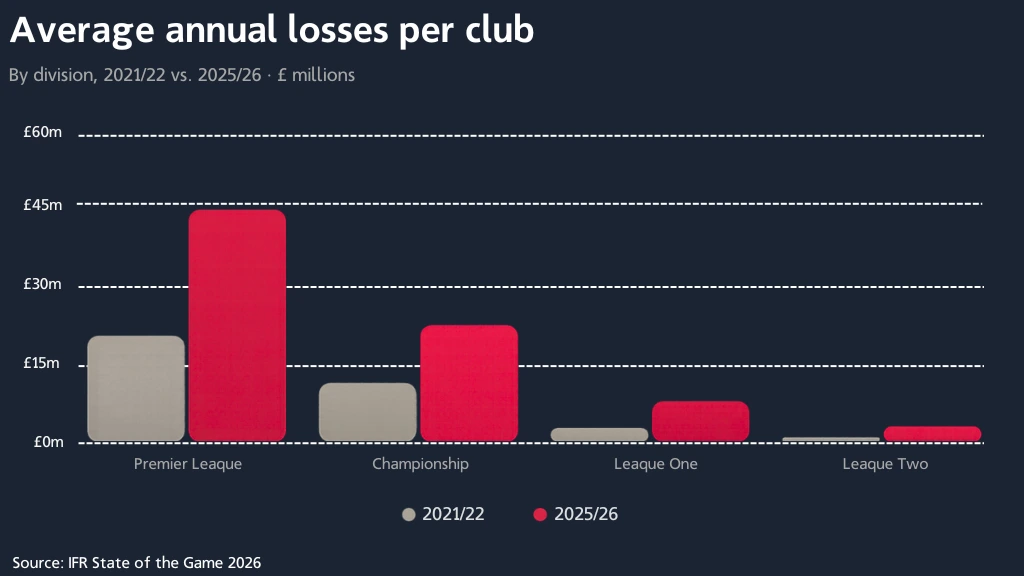
The IFR report demonstrates how far this pressure extends. Between 2021/22 and 2025/26, player wages increased by 33% in the Premier League, but by an astonishing 71% in League One and 63% in League Two. The average Championship club recorded an annual loss of approximately £22 million.
And perhaps most revealing, 17 clubs would still have been loss-making even without paying their players.
This is no longer simply a question of excessive player salaries. It points toward a business model in which the cost of operating and competing increasingly exceeds what many clubs can sustainably generate.
Growing revenues, growing obligations
Manchester United illustrates another dimension of the problem. Despite inconsistent sporting performances over recent years, the club remains a global commercial powerhouse. In its 2026 financial year, United generated record revenues of £677.6 million, yet reported a net loss of approximately £43 million and total indebtedness of £689 million.
At the same time, the club is pursuing plans for a new 100,000-seat stadium, an investment intended to unlock significant future commercial opportunities.
There is a sound business argument for developing facilities that generate additional matchday, hospitality, sponsorship and event revenues. Debt, after all, is not inherently irresponsible when it finances productive assets.
But stadiums require substantial capital, financing creates obligations, and future revenues are never guaranteed. A club can become more valuable on paper without necessarily becoming more financially resilient.
This is where the industry faces a difficult balancing act. The pursuit of sporting success encourages investment, while the consequences of overspending can threaten the very institutions that owners are trying to strengthen.
Financial regulation has attempted to address this tension, although not without controversy.
Spain's LaLiga has developed a system of preventive financial controls, linking permitted sporting expenditure to each club's financial capacity. The Premier League has also introduced new squad-cost and financial resilience rules for the 2026/27 season. Meanwhile, Manchester City's financial-rule proceedings have highlighted the importance of credible enforcement and trust in the competitive system. The club disputes the findings against it and has appealed.
Yet regulation presents a dilemma of its own. If clubs can only spend according to their existing economic strength, how can ambitious challengers close the gap to the wealthiest institutions? Financial rules may protect sustainability while simultaneously reinforcing the advantages of established clubs.
It is a difficult balance between financial responsibility and the opportunity to compete.
The same challenges exist closer to home
From my experience working in Canadian soccer, I have seen how challenging it can be to reconcile the ambition of professional sport with the commercial realities of running a club.
The expectations are substantial. Clubs need competitive squads, capable staff, suitable facilities, and an organization that can deliver a professional experience. Yet the revenue opportunities are far more limited than those available to established European clubs.
Attendance, sponsorship, stadium agreements, travel expenses and the cost of operating in a developing professional sports market all influence the financial equation. And building a loyal audience and recurring commercial revenues takes time.
External investment is often essential, particularly during the early years of developing a club. There is nothing inherently wrong with owners funding that growth. Without investors willing to accept financial risks, many professional sports opportunities would never exist.
But there is a difference between financing a deliberate development strategy and continuously funding an operating model that cannot sustain itself.
At what point does the investment phase become a permanent dependence on capital calls?
That is a question every emerging professional league and club should be asking.
If the economics are so difficult, why do investors keep buying?
This may be the most fascinating contradiction in modern professional sport.
Even as clubs struggle financially, their valuations continue to attract attention. The National Women's Soccer League provides a striking example. Atlanta's reported expansion fee reached US$165 million, followed by Columbus at US$205 million. With the league now exploring further expansion toward 20 clubs, investor demand appears substantial.
These figures demonstrate growing confidence in the future of women's professional soccer. But they also raise an important question: what exactly are investors buying?
Current profitability? Future broadcasting and sponsorship revenues? Access to a scarce professional franchise? Or the expectation that someone will pay considerably more for the asset in ten years?
Most likely, it is a combination of these factors.
There is nothing necessarily unreasonable about investing in future growth. But the price an investor is willing to pay for a sports property does not automatically reflect the financial strength of the underlying organization. An expansion fee, for example, establishes the cost of entry into a league, not the profitability or independent valuation of every club within it.
Everton presents another interesting perspective.
The Friedkin Group acquired the club in December 2024, helped stabilize its financial position and supported the completion of its new stadium on Liverpool's waterfront. Now, less than two years later, the ownership group is exploring new investment options, including a potential sale of a controlling interest.
There may be entirely legitimate reasons for such a transition. Different investors have different capabilities, objectives and investment horizons. An ownership group that stabilizes a struggling club may not necessarily be best positioned to finance its next phase.
But it raises a broader question about what we consider successful sports ownership.
Is the objective to increase the valuation and eventually realize a financial return? To win trophies? To strengthen the organization commercially? Or to build an institution capable of thriving for generations?
These objectives are not necessarily mutually exclusive, but they don't always align either.
And unlike most conventional investments, football clubs have an identity and responsibility that extend beyond their shareholders. Their supporters, history and place within their communities remain long after individual owners have moved on.
What are we actually trying to build?
Football clubs in its conception were not made to maximize profit. An owner may legitimately choose to finance sporting ambition, community development or a long-term vision that extends beyond immediate financial returns.
But those decisions need to be intentional, supported by adequate capital and governed responsibly.
A club should understand what it is trying to achieve, what those ambitions will cost, and how it intends to finance them. Its executives must develop the commercial capabilities, organizational structures and revenue foundations necessary to deliver. And its ownership must be prepared to confront the consequences when sporting ambition and financial reality begin to diverge.
The alternative is an organization whose future depends less on its own strength than on the continued willingness of someone else to finance it.
That is a dangerous position for any institution, particularly one carrying the expectations and loyalties of an entire community.
At Athlos, this is central to the work we do with sports organizations. We help clubs, leagues and ownership groups connect their ambitions with clear strategic direction, commercial development, accountable leadership and sustainable operating models.
Because the objective should not simply be to build a more valuable sports property. It should be to build an organization capable of delivering lasting value.
The real vulnerability in football is not simply the use of debt, outside capital or ambitious investment. It is when the pursuit of competitive success and asset appreciation becomes disconnected from an organization's ability to finance its own future.
Football's commercial growth is remarkable, and there are good reasons to be optimistic about its future. But growing revenues, rising franchise prices and increasing investor interest should not distract us from the condition of the clubs themselves.
The IFR report is an important reminder that the financial health of a sport cannot be measured by the size of its industry alone.
And it leaves us with a question that I believe every sports owner and executive should consider:
Are we building football clubs that are becoming more valuable, or football clubs that are actually becoming stronger?
Sources and further reading