From multi-club ownership to integrated ecosystems
I started paying closer attention to sports ownership groups around 2014. At the time, the idea of building portfolios of clubs and sports properties was still relatively uncommon. Red Bull and City Football Group were among the more visible examples in football, but there were far fewer organizations operating this way than there are today. Deloitte, using UEFA data, estimates that fewer than 60 football clubs worldwide were part of multi-club investment structures in 2014. By 2024, that number had grown to 342.
What interested me even then was not simply the idea that an owner could buy several clubs. The more interesting question was what those clubs could do together that they could not do as effectively on their own. Could knowledge move between markets? Could player pathways become stronger? Could commercial expertise be shared? Could one club avoid making a mistake because another had already learned from it? In other words, was the value really in owning several assets, or was it in how those assets were connected?
That question has only become more relevant over the last decade. City Football Group has become one of the clearest examples of a multi-club model, with interests across 12 clubs and a stated approach of sharing expertise across talent development, fan experience, commercial opportunities and community impact while trying to preserve each club's local identity. Other groups have followed different versions of the same broad idea. Some have built around several clubs in different countries. Others have built across sports or around a specific strategic purpose.
The model is no longer unusual. But it is also not one model.
That is what makes the Rogers story particularly interesting.
Why Rogers is different
Rogers is not simply building a multi-team portfolio. It is building something much closer to a vertically integrated sports, media and entertainment business.
On October 1, Rogers completed its acquisition of the remaining 25% of Maple Leaf Sports & Entertainment for C$4.35 billion, taking its ownership of MLSE to 100%. Through MLSE, it now controls the Toronto Maple Leafs, Toronto Raptors, Toronto FC, Toronto Argonauts, Scotiabank Arena, affiliated development teams and a partnership with Live Nation. Those assets now sit alongside the Toronto Blue Jays, Rogers Centre, Sportsnet, more than 30 television networks and more than 40 radio stations. Rogers has also announced the creation of a new Rogers Sports business unit that will bring its sports, media and entertainment businesses together. (Article continues below image)
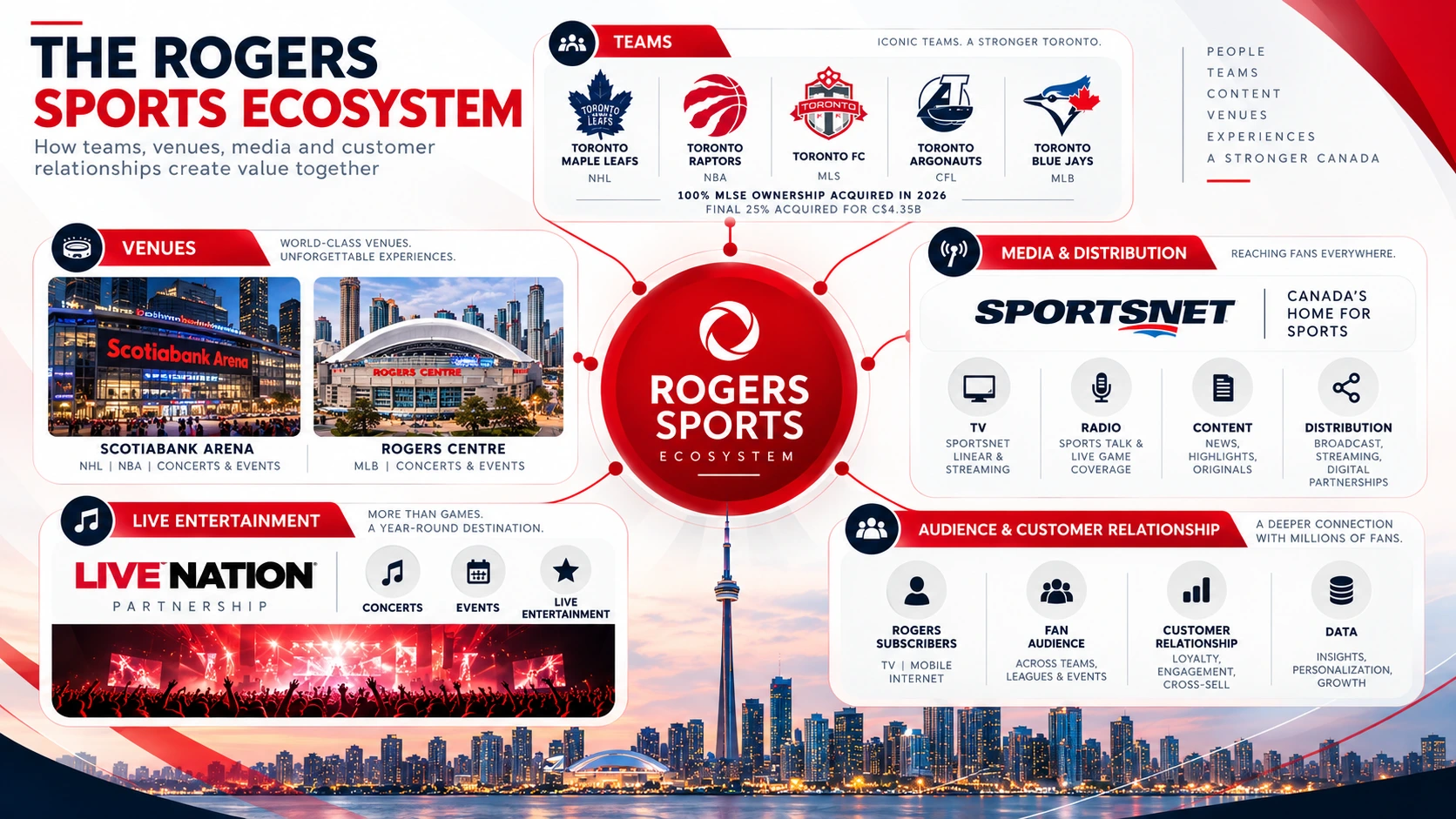
When you look at that list, the temptation is to focus on the scale. The teams are valuable. The venues are valuable. The media assets are valuable. The customer base underneath Rogers' communications business is enormous. But I think the more useful question is what Rogers can now make possible between those assets.
A vertically integrated business can participate in several stages of the same customer relationship. Rogers owns sports properties that create content and experiences. It owns media that distributes that content. It owns venues where people experience the product in person. It has commercial relationships wrapped around those teams and venues, and it has an enormous communications business beneath all of it.
A fan can watch the Maple Leafs on Sportsnet, attend a Raptors game at Scotiabank Arena, follow the Blue Jays throughout the summer, consume team content during the week, attend a concert or event, interact with sponsors across those properties and already have an existing relationship with Rogers through other services. That does not mean all of those relationships should simply be merged or monetized in the same way. It does mean Rogers has far more opportunities to connect them than a sports organization that controls only one part of that journey.
This is also where vertical integration can create resilience. Sports businesses are often exposed when too much depends on one source of revenue or one type of relationship. A club that depends heavily on ticketing is vulnerable when attendance falls or access to the venue is disrupted. An organization heavily dependent on one media agreement carries another kind of risk. A business with several connected revenue engines, different ways to reach its audience and greater control over how its product is distributed has more options when one part of the system comes under pressure.
That does not make vertical integration automatically superior. More assets also mean more complexity. More brands need leadership, more systems need to work together, more decisions need coordination and more stakeholders have legitimate interests that need to be considered. A large integrated business can easily become slower and less focused if its operating model does not keep up with its portfolio.
That is why the next stage for Rogers may be more interesting than the transaction itself.
Owning the assets is only the beginning
The transaction is complete, but the operating model is not. Rogers has said it will now determine the best operating model for Rogers Sports. That line may ultimately matter more than the acquisition itself. Buying the assets brought them under one ownership structure. The next challenge is designing how they should actually work together.
That distinction matters far beyond Rogers.
Most sports organizations already have some version of an ecosystem, even if they have never called it that. A club may have a first team, academy, development programs, camps, community initiatives, sponsors, events, content, supporters and perhaps a facility. Usually those pieces did not appear because somebody sat down at the beginning and designed a perfectly connected organization. They accumulated over time. One program solved a need. Another emerged because there was demand. Sponsorship developed in one direction, the academy in another, and marketing began focusing on whatever needed attention most urgently.
There is nothing inherently wrong with that. Organizations grow this way all the time. The problem comes when the number of activities grows faster than the connections between them. You can end up with a very busy organization without having a particularly strong ecosystem.
That is where I think leaders need to look at growth differently. The question should not always be, What else can we add? It may be more useful to ask, Are the things we already have creating enough value for one another?
Take the relationship between a first team and an academy. The sporting connection is usually obvious: young players should be able to see a pathway toward higher levels of competition. But the relationship can be much broader. Do academy families feel part of the club? Do they attend first-team matches? Do they become supporters over time? Does first-team content give young players something tangible to aspire toward? Can sponsors interact meaningfully with both audiences? Is the academy helping build the future supporter base as well as the future player base?
Community programming provides another example. Many clubs do excellent community work, but those initiatives can sit almost entirely apart from the commercial side of the organization. A community program can deepen local trust, create relationships with families and demonstrate what the club stands for. For the right commercial partner, that may be far more valuable than another logo placement. The point is not to commercialize every community relationship. It is to understand how the different parts of the organization strengthen the whole.
Facilities are similar. A facility can simply be somewhere the team trains and plays. Or it can become a place where development programs, events, community activity, commercial partners, hospitality and other organizations interact. The same physical asset can play a very different strategic role depending on how the organization connects it to everything else.
This is where the idea of an ecosystem becomes useful. Not when we draw circles around everything the organization owns, but when we start examining the lines between those circles.
Five questions that turn a collection into an ecosystem
There are five questions I would use to begin that work. They are not complicated, but together they force an organization to move beyond simply listing its programs and assets.
1. Purpose — Why does this belong?
The first question is why each part belongs in the organization in the first place. If a club is launching another program, entering another market, adding another team or investing in a property, there should be a reason that goes beyond the opportunity simply being available.
With Rogers, there is an understandable logic connecting the pieces. Sport creates premium content and live experiences. Media distributes that content. Venues bring people together around the experience. Telecommunications creates another relationship with many of those same customers. The assets are different, but there is a strategic line connecting them.
Smaller sports organizations should expect the same clarity from themselves. If you operate an academy, what role does it play in the wider club? If you run a tournament, what does it create beyond tournament revenue? If you build a facility, what does that facility make possible for the rest of the organization? If you add another team, how does it strengthen the sporting, commercial or community system around it?
There does not need to be one correct answer. But there should be an answer. Otherwise growth can slowly turn an organization into a collection of things that all seemed like good ideas when they were added.
2. Connection — What should this make stronger?
Once we know why something belongs, the next question is what else inside the organization it should strengthen.
An academy should obviously contribute to the sporting pathway, but perhaps it should also deepen the club's connection with families and create future supporters. Community programming may deliver its own mission outcomes while also strengthening the club's identity, its relationships with local partners and the value it can offer certain sponsors. A facility may support football operations while also becoming an event, community and commercial asset.
The point is not that every part must support every other part. That would become forced very quickly. The point is that leaders should know where the important connections are supposed to exist.
If two major parts of an organization operate beside one another year after year without either becoming stronger because of the other, it is worth asking whether an opportunity is being missed.
3. Flow — What should move between the pieces?
Connection becomes more tangible when we ask what should actually move from one part of the ecosystem to another.
Sometimes it is people. A player progresses through a pathway, or a family moves from participating in a youth program toward becoming long-term supporters of the club. Sometimes it is knowledge. One team learns something about ticketing, partnerships or fan engagement that another part of the organization can use. In other cases, what moves may be content, data, sponsors, facilities, capital or expertise.
City Football Group illustrates this clearly. Its model is built not only around common ownership but around access to shared expertise, technology, strategic advice, commercial capabilities and sporting knowledge. Even its relationships with partner clubs are designed around the transfer of capability rather than ownership alone.
The same question works at almost any scale: What should move through our system that currently stops at the edge of one department, program or team?
That is often where hidden value sits.
4. Capability — What should we share, and what should remain distinct?
As ecosystems grow, another tension appears. Sharing capabilities can create efficiency and improve quality, but efficiency should not be confused with making everything the same.
Sports properties carry identity. That identity is often deeply local. A supporter does not experience a club as a business unit inside an ownership portfolio. History, place, rivalries, relationships and community all matter.
The Toronto Raptors do not need to feel like the Toronto Maple Leafs because they sit inside MLSE. Toronto FC has its own supporter culture, and the Blue Jays are different again. The opportunity for Rogers is to share what creates advantage without flattening what makes the individual properties valuable.
A smaller organization faces the same question. Finance may benefit from one system. CRM should probably be connected. Sponsorship processes may benefit from shared structure. Data should flow, and leadership should share a clear strategy. At the same time, different teams, programs and communities may require different identities and different ways of operating.
The question is therefore not simply, How much can we centralize? It is, Where does shared capability create value, and where does distinctiveness create value?
5. Value — How will we know the connection is working?
Finally, the organization has to prove that these connections are creating something useful.
Synergy is easy to talk about. It is harder to demonstrate.
If an academy is supposed to strengthen the wider club, are more academy families becoming supporters? If sponsorship is supposed to work across the organization, are partners using several parts of the ecosystem and renewing because of it? If a facility is supposed to become a broader organizational asset, is it generating more revenue, more community use or more programming opportunities? If functions are being centralized, is expertise moving faster and quality improving, or has the organization simply added another layer of management?
This is also where the argument about resilience becomes measurable. Has the organization developed several healthy revenue engines? Does one part of the system continue creating value when another comes under pressure? Has the organization become less dependent on a single customer, program, sponsor or revenue source?
If those outcomes are not visible, then the connections may exist mainly on the organizational chart.
The opportunity may already be inside the organization
This is where the Rogers story becomes useful for sports leaders, owners and investors at every level. You do not need to own five professional teams, a media network and major venues to think this way. You can start with the organization you already have.
Put its major parts on one page: the first team, academy, development programs, community initiatives, events, facilities, sponsors, content, supporters, members and partners. Then work through the same five questions. Why does each part belong? What should it strengthen? What should move between the pieces? Which capabilities should be shared? And what evidence would tell you that the connection is actually producing value?
That exercise may change the next strategic conversation. You may discover that the organization does not need another program, another property or another initiative nearly as much as it needs better connections between the assets it already has. There may already be audiences that should know about another part of the organization, commercial partners that could engage more broadly, facilities that could serve another purpose, knowledge that should be shared, or programs that could reinforce each other far more intentionally.
In other words, the next source of growth may already be inside the organization.
What happens next will tell us whether Rogers has built an ecosystem
That is why I will be watching Rogers Sports closely. The C$4.35 billion acquisition gives Rogers an extraordinary collection of assets, but the acquisition itself does not tell us whether the strategy will work. What comes next will be far more revealing: how the company connects sports, media, venues, audiences and customer relationships while preserving the identity and value of the individual properties inside the group.
The scale is unusual, but the underlying management question applies to almost every ambitious sports organization. As organizations grow, they naturally add teams, programs, people, partners and assets. The strategic work is making sure those additions eventually become something more than a collection.
That is where the real value of a sports ecosystem lies: not simply in what the organization owns, but in how well the pieces make one another stronger.